Posts

Showing posts with the label CORE

Journal club: Trying something different

When my annual turn at scheduling CORE's origins journal club came up this semester (Roger Sanders and I alternate semesters), I decided I wanted to try something different. Recall that the goal of journal club is to keep apprised of the latest publications relevant to the creation/evolution issue, especially publications by Bryan College faculty or students. Rather than just pick some interesting papers at random, I decided to shoot for an overarching theme. This may be the only time we ever have a journal club theme, but I thought it was worth trying. Our theme for this semester is "Faith and Science in Dialogue." Here's the schedule: January 24 : Special presentation by Michael Gulker. Michael Gulker is executive director of the Colossian Forum , and he will be presenting on the work of the Colossian Forum. According to their website: In an age of increased fear and animosity over issues of science, faith and culture, The Colossian Forum reminds believers ...
Jon Ahlquist is coming

Here's a very brief update to our journal club schedule this fall: On October 25, we will be welcoming a very special guest speaker to the Bryan College campus. Ornithologist Jon Ahlquist will be giving a presentation on his research at 5 p.m. in Mercer Hall 137. Dr. Ahlquist worked with Charles Sibley for 30 years on studies of genome similarity and bird classification and co-authored with Sibley the 1990 book Phylogeny and Classification of Birds from Yale University Press. Feedback? Email me at toddcharleswood [at] gmail [dot] com.

Fall journal club schedule

Each semester, CORE sponsors a discussion group on campus to examine recent publications that are relevant to the creation/evolution debate.  We meet every other Tuesday in Mercer 137.  If you are on campus or nearby and you'd like to participate, we welcome you.  The schedule for the fall semester has been posted at the CORE website.  Check it out if you can! Feedback? Email me at toddcharleswood [at] gmail [dot] com.

Coming up

The summer is rapidly coming to a close. I've returned from the last of my travels, I'm seeing a lot of my faculty colleagues on campus again, and in one short week, I'll be in faculty workshop again. I didn't even get half the stuff done this summer that I wanted to. That's pretty typical though. So what's coming up this fall from CORE? Roger and I will be working on several special issues of JCTSB , including one on the baramin . That means we'll be writing some new papers summarizing some of our research on carnivorous plants and the verbena family. I'll also be working with Marcus Ross and Paul Garner on our Avialae paper. To top all that off, I've started a significant research project as a response to Senter's criticisms. It goes way beyond dinosaurs, though, and it could potentially change everything that's been happening in baraminology over the last decade. Big stuff. Over at the Creation Biology Society, I've alread...

From the Library: Hunter's Elements of Biology

Image
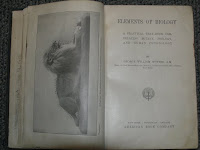
For those just joining us, "From the Library" spotlights interesting items in the library of the Center for Origins Research at Bryan College . While browsing in a local antique mall in Dayton recently, I stumbled upon a bookcase full of old textbooks. To my delight, I found George William Hunter's 1907 Elements of Biology , the predecessor to his 1914 textbook A Civic Biology that featured prominently in the famous Scopes trial. Best part? It was only $2. I love a good bargain. I've only briefly skimmed the book, but it appears that the concept of evolution occupies a much lower place in this volume than in A Civic Biology . That's not to say that the later textbook covered evolution in great detail. Evolution appears briefly in A Civic Biology when classification and heredity are discussed. In Elements of Biology , evolution appears to be barely mentioned. On page 7 of the introduction we read, "In the second half year the so-called evolutio...

Roger Sanders radio interview

Just wanted to let you know that CORE's Roger Sanders was recently interviewed by Bob Enyart for his program "Real Science Friday." You can listen online here: Roger Sanders interview Feedback? Email me at toddcharleswood [at] gmail [dot] com.

Kurt Wise at SAU

Kurt Wise is lecturing at Southern Adventist University this week. He'll be giving a talk titled "Caves: eroded up or down?" at 7:30 p.m. on Thursday, April 14 in the Hulsey Wellness Center. He'll also be speaking in chapel that morning (11 a.m.) on "Our dominion responsibility to the creation." Dr. Wise is professor of biology and chair of the Division of Science and Math at Truett-McConnell College in Cleveland, GA and former director of CORE at Bryan College. Feedback? Email me at toddcharleswood [at] gmail [dot] com.

CORE discussion group: Spring schedule

For you locals or even semi-locals, every semester CORE organizes a discussion group to talk about the latest issues in the creation/evolution debate. The group meets every other Tuesday in Mercer Hall 132 at 5 pm. Our first discussion this semester will be TODAY at 5 pm! CORE director Todd Wood (that's me) will explore the relevance of the doctrine of creation to Christians. Some say that to be a good Christian you MUST be a young-earth creationist. Others say that the Bible doesn't teach anything about the mechanism of creation and you can believe whatever you want. What does this debate mean to you? What does it mean to Bryan College? Does it matter at all? Come and find out! The rest of the schedule is posted at the CORE website . If you're in the area and interested, we'd love to have you stop by. Feedback? Email me at toddcharleswood [at] gmail [dot] com.

Catholic perspective on creation/evolution

I'm pleased to announce that Hugh Owen, the director of the Kolbe Center for the Study of Creation , will be visiting the Bryan College campus in November to present a lecture on the creation/evolution debate from a Catholic perspective. The Kolbe Center is the leading young-age creationist advocacy group among Catholic Christians, and Mr. Owen's lecture will give our students an excellent opportunity to view the creation/evolution debate from a different theological tradition altogether. Mr. Owen will speak on Monday evening, November 15 at 5:00 p.m. in Mercer Hall 139 (the classroom right across the hall from the Henning Museum). The lecture will last about 45 minutes and is free to the public. Mr. Owen's lecture is part of the ongoing journal club meetings sponsored by the Center for Origins Research at Bryan College . Feedback? Email me at toddcharleswood [at] gmail [dot] com.

Fall 2010 journal club schedule

For you locals, the journal club schedule for the fall semester has been posted here . It's open to anyone and everyone. What is journal club? The Origins Journal Club is designed for those interested in origins or the work of CORE to meet together and discuss recent literature or research results. The format is a short presentation (25-35 minutes) followed by discussion. Presentations can be a summary of a published article or an original research project and may be given by a professor or student. Journal Club meets Tuesdays at 5:00 p.m. in Mercer 139. Feedback? Email me at toddcharleswood [at] gmail [dot] com.

What's the point of blogging?

I was asked recently to explain the purpose of blogging, specifically what is the purpose of my blog. That set me to thinking about my own history with creationism, and what I wanted to accomplish with this blog. I suppose the question has a broader implications for the general motivation for blogging (which often escapes me), but I'm taking more along the lines of why I chose to blog about creation, evolution, theology, and science. First and foremost, this is an information channel for supporters of CORE . I've tried all sorts of means to keep people aware of the goings on at CORE, but there's nothing as simple and easy as blogging. Since I am first and foremost a researcher, I don't really like to spend a lot of time writing newsletters and such. With the blog, I just post stuff as I'm reminded of it. Very convenient. Second, this is sort of a notebook for my ideas and for papers that interest me. It's a convenient way to keep track of papers or presen...

From the Library: On Some Instances of the Power of God

Image
For those just joining us, "From the Library" spotlights interesting items in the library of the Center for Origins Research at Bryan College . This week's book is an extraordinary look into Sir Richard Owen's understanding of design. The volume it appears in is titled Lectures Delivered before the Young Men's Christian Association, in Exeter Hall, from November, 1863, to February, 1864 . Owen's lecture is titled "On Some Instances of the Power of God as Manifested in His Animal Creation." There is also a longer book form of this lecture, but I haven't been able to obtain a copy. This condensed version still contains quite a powerful argument. And that makes me sort of sad. As I read this essay, I thought about the ID debate and my evolutionary creationist brothers in Christ, and I wished any of them could write anything remotely as compelling as Owen had. He almost convinced me... but not quite. The lecture is divided into roughly t...

Henning Museum sneak peak

Image
Some readers might know that I double as curator of the Henning Museum at Bryan College in addition to my duties as CORE director. We've been really busy this summer upgrading some of our exhibits, and I wanted to give you a sneak peak. We quadrupled the number of shells on display. This is the museum's most significant collection, and we wanted to put as much of it on display as we could, which is to say we've put maybe 2-3% of it on display. We also added a giant clam to the exhibit. It's not big enough to bathe in, but it's still pretty large. We reworked and expanded our skull exhibit. Joining the lion, leopard, and various local critters are the North American porcupine, a jackrabbit, and casts of a dugong and a giant beaver. Our mineral exhibit got a huge boost from a donation of six beautiful specimens from Bulgaria and the acquisition of a huge amethyst geode. Very nice. In addition to many locally-collected insects and spiders, our new arthropod exhi...

From the Library: "After its Kind"

Image
For those just joining us, "From the Library" spotlights interesting items in the library of the Center for Origins Research at Bryan College . Longtime readers will recall my ambivalence towards mendelian models of speciation: Mendel is not enough Mendel is REALLY not enough Very briefly, the model posits that God created organisms with a fixed set of alleles (gene versions). As time went on and the populations began to spread out, certain combinations of alleles became fixed in certain populations, and those populations became species. As I wrote previously , This model is still quite popular with creationists for what I consider to be mostly psychological or apologetic reasons: (1) It does not require the generation of new attributes or "genetic information" (whatever that is) after creation. (2) All changes can be perceived as degenerative, since the originally created heterozygous condition is broken up and disturbed as species separate out alleles...

From the library: Noe Architectus Arcae

Image
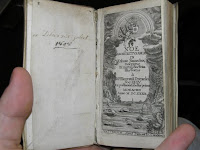
For those just joining us, "From the Library" spotlights interesting items in the library of the Center for Origins Research at Bryan College . The full title of this week's book is Noe Architectus Arcae in Diluvio Navarchus Descriptus et Morali Doctrina Illustratus . It was written by a German Jesuit named Jeremias Drexel and published in Antwerp in 1640. Our copy is a first edition. Drexel was quite well-known in his own time. He wrote thirty different books (nine published posthumously), and during the last twenty years of his life, more than 150,000 copies of his books were sold. I'm highlighting this book not because I've read it (which I haven't - it's entirely Latin), but because it exemplifies an interesting historical trend on Noah's Ark. In 1554, a French monk named Johannes Buteo published a pamphlet that attempted to analyze the logistics of Noah's Ark, its structure, how it was built, how many animals it carried, how much ro...

From the Library: Evolution and the Bible

Image
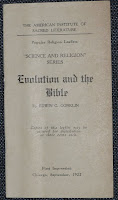
For those just joining us, "From the Library" spotlights interesting items in the library of the Center for Origins Research at Bryan College . During the heyday of Bryan's antievolution movement, there were plenty of opponents of Bryan's crusade. It's easy to think of non-religious or even anti-religious individuals (like Mencken or Darrow), but there were plenty of religious folk upset with him too. One such opponent was Edwin G. Conklin. Conklin was a developmental biologist and professor at Princeton. He was president of the American Society of Naturalists and eventually of the American Association for the Advancement of Science. In 1922, he wrote a little leaflet for the American Institute of Sacred Literature called "Evolution and the Bible." It is an archetypal anticreationist tract. All the major arguments I hear again and again are already there. Here's a few quotes you'll find familiar: It is a dangerous thing for defenders of t...

From the Library: Comparisons of Structure in Animals. The Hand and the Arm

Image
For those just joining us, "From the Library" spotlights interesting items in the library of the Center for Origins Research at Bryan College . I was searching online the other day for nineteenth century comparative anatomy books, and I stumbled across this title. I'd never heard of it before, but I couldn't resist. An anonymously authored book on the comparative anatomy of vertebrate forelimbs published by the American Sunday-School Union? That's right up my alley. Fortunately, such an obscure work was not expensive. According to WorldCat , the original book was published in England around 1848 by the Religious Tract Society. Its unnamed author was one William Charles Linnaeus Martin , onetime curator of the Zoological Society's museum and author of many nature books for general audiences. When I saw the title, I wanted to know whether the book would follow the pattern of Richard Owen's roughly contemporaneous On the Nature of Limbs or Charles Bel...

Sediba at BSG

It's official: I got word from my editor this week that my abstract on Australopithecus sediba has been accepted for this summer's BSG conference. This abstract describes a new analysis of postcranial characteristics that was not part of my ARJ paper but will become part of my response to any critics who happen to crop up in the next few weeks (yes, I know you're out there). Register for the BSG conference here . Feedback? Email me at toddcharleswood [at] gmail [dot] com.

Coming up...

My summer's going to be busy, so here's a preview. At the end of this month I'll be in Portland for Evolution2010 . As I did last year, I'll be posting my impressions of the conference. In July, I'll be speaking at Bryan College's Summit . Although I'm not yet listed on the speaker page, I'll be speaking on July 8 and 27. I'll be giving two presentations that will be similar to what I presented at Messiah College back in April. At the end of July, I'll be at BSG giving two talks, one on mammal baramins and the other on Australopithecus sediba (I just submitted my abstract revisions today). If you've been looking for an occasion to grill me on sediba , there's still plenty of room at the BSG conference, July 28-31 at Truett-McConnell College in Cleveland, GA ( register here ). Somewhere in that schedule, I'm going to squeeze in my first real vacation in several years (vacations piggy-backed on conferences don't count). I...

Pondering the Image of God

After reading my sediba paper, one of my students asked, "Why would God allow such similarities between His created Image and another portion of Creation?" Great question. I don't have the answer, but if we reflect a little on the image of God, we might begin to understand the question a little better. First of all, the concept of the "image of God" appears most prominently in Genesis 1: 26-27: Then God said, "Let us make man in our image, after our likeness. And let them have dominion over the fish of the sea and over the birds of the heavens and over the livestock and over all the earth and over every creeping thing that creeps on the earth." So God created man in his own image, in the image of God he created him; male and female he created them. ( ESV ) The image of God also appears in Genesis 9:6, "Whoever sheds the blood of man, by man shall his blood be shed, for God made man in his own image" (ESV). It has a few obvious parallels, a...